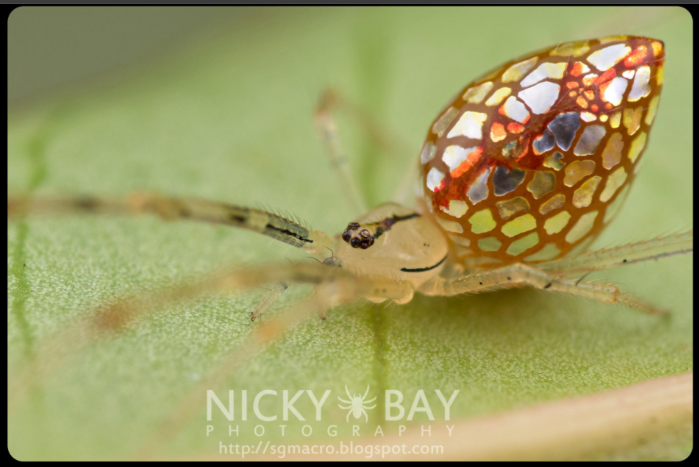
'[They] look like tiny disco balls': Meet the Mirror-Ball Spider, the tiny dancer sparkling all over the tropic zone of the world

Advertisement
  • 01
    Mirror-Ball Spiders: these spiders are covered in shimmering, mirror- like panels that can shrink or expand; the panels are produced by a digestive secretion known as guanine, which seeps into the lining of the spider's gut and forms crystalline structures just beneath the surface of the abdomen
  • 02
    NICKY BAY PHOTOGRAPHY http://sgmacro.blogspot.com
  • 03
    Cheezburger Image 10643398400
  • 04
    itsswhitneywhspr Ok wait the fact that this is basically the same stuff that gives fish scales their shine is blowing my mind. Nature really recycled the same sparkly ingredient for both spiders and fish and were just here wearing glitter we bought at the craft store.
  • 05
    Alt0173 Natures recycles all the time. Our lungs are parts of our stomach that got repurposed millions and millions of years ago.
  • 06
    Cheezburger Image 10643398912
  • 07
    SixteenSevered Hands OP Spiders of the genus Thwaitesia are often described as mirror-ball spiders, because their bodies are lined with reflective panels that make them look like tiny disco- balls. They're also known as dewdrop spiders or sequined spiders.
  • 08
    The shimmering panels are produced by a digestive secretion known as guanine, which seeps into the tissue that surrounds the spider's gut, forming crystalline cells just beneath the surface of the abdomen. These crystals shift and expand as the muscles in the spider's abdomen contract; they often shrink when the spider is agitated, and they expand as it begins to relax.
  • 09
    The adaptive purpose of this effect is unclear, but researchers believe that the panels may mimic the glistening appearance of raindrops or beads of dew, which could allow the spiders to blend in with their environment. The scattered light may also help to confuse predators, as this article explains:
  • 10
    Cheezburger Image 10643408640
  • 11
    The spider's decorative patterning may seem like a de d give-away to predators, but for those looking to feast on this arachnid, the hunt might result in confusion and failure.
  • 12
    "Like a disco ball with lots of different mirrors, the reflective splotches on the spider's abdomen probably scatter light and make it difficult for predators to see it," says Robert Whyte, an honorary researcher in arachnology at the Queensland Museum.
  • 13
    2017 NICKY BAY www.nickybay.com
  • 14
    There are at least 22 known species of mirror-ball spider, and their physical features can vary significantly. In some cases, the silver panels on the abdomen are accompanied by colorful, iridescent spots and scales, and the abdomen itself may have a red, orange, green, yellow, or beige appearance.
  • 15
    These spiders are widely distributed throughout the southern hemisphere. They can be found in the tropical and neotropical rainforests of South America, Southeast Asia, Africa, Australia, India, Sri Lanka, China, Singapore, and Madagascar.
  • 16
    Mirror-ball spiders are not aggressive toward humans, and there are virtually no recorded cases of humans being bitten by the spiders of this genus. They're also tiny, with most individuals measuring just 2-4mm long (roughly 1/10th of an inch), which means that their fangs are often too small to penetrate human skin.
  • 17
    Cheezburger Image 10643409408
  • 18
    Sassy_Sober_Sister17 Thank you for letting me know where I'll not be visiting! I'm terrified of spiders. I can't even fully appreciate this little guy! ED
  • 19
    ©2014 NICKY BAY www.nickyboy.com
  • 20
    Cheezburger Image 10643429632

Tags

Scroll Down For The Next Article